Data protection privacy notice for patients
Introduction
This privacy notice lets you know what happens to any personal data that you give to us, or any that we may collect from or about you.
This privacy notice applies to personal information processed by or on behalf of the practice.
This notice explains:
- Who we are and how we use your information
- Information about our Data Protection Officer
- What kinds of personal information about you we hold and use (process)
- The legal grounds for our processing of your personal information (including when we share it with others)?
- What should you do if your personal information changes?
- For how long your personal information is retained or stored by us
- What your rights are under Data Protection laws
The UK General Data Protection Regulation (UKGDPR) and the Data Protection Act 2018 (DPA 2018) became law on 25th May 2018, and 1st January 2021 when the UK exited the EU.
For the purpose of applicable data protection legislation (including but not limited to the General Data Protection Regulation (Regulation (UK) 2016/679) (the “UKGDPR”), and the Data Protection Act 2018 the practice responsible for your personal data is Arden House Medical Practice.
This Notice describes how we collect, use and process your personal data, and how in doing so, we comply with our legal obligations to you. Your privacy is important to us, and we are committed to protecting and safeguarding your data privacy rights.
How we use your information and the law. Arden House Medical Practice will be what’s known as the ‘Controller’ of your personal data.
How we use your information and the law
We collect basic personal data about you which does include special types of information and location-based information. This does include name, address, medical conditions, contact details such as email and mobile number etc.
We will collect sensitive confidential data known as “special category personal data”, in the form of health information, religious belief (if required in a healthcare setting) ethnicity, and sex life information that are linked to your healthcare, we may also receive this information from other health providers or third parties.
Why do we need your information?
The health care professionals who provide you with care maintain records about your health and any treatment or care you have received previously. These records help to provide you with the best possible healthcare and treatment.
NHS health records may be electronic, paper-based or a mixture of both. We use a combination of working practices and technology to ensure that your information is kept confidential and secure.
Records about you may include the following information:
- Details about you, such as your address, carer, legal representative and emergency contact details.
- Any contact the surgery has had with you, such as appointments, clinic visits, emergency appointments.
- Notes and reports about your health.
- Details about your treatment and care.
- Results of investigations such as laboratory tests, x-rays etc.
- Relevant information from other health professionals, relatives or those who care for you.
- Contact details (including email address, mobile telephone number and home telephone number)
To ensure you receive the best possible care, your records are used to facilitate the care you receive, including contacting you. Information held about you may be used to help protect the health of the public and to help us manage the NHS and the services we provide. Limited information may be used within the GP practice for clinical audit to monitor the quality of the service we provided.
How do we lawfully use your data?
We need to know your personal, sensitive and confidential data in order to provide you with Healthcare services as a General Practice, under the General Data Protection Regulation we will be lawfully using your information in accordance with:
- Article 6, e) processing is necessary for the performance of a task carried out in the public interest or in the exercise of official authority vested in the controller;”
- Article 9, (h) processing is necessary for the purposes of preventive or occupational medicine, for the assessment of the working capacity of the employee, medical diagnosis, the provision of health or social care or treatment or the management of health or social care systems
This privacy notice applies to the personal data of our patients and the data you have given us about your carers/family members.
We use your personal and healthcare information in the following ways:
When we need to speak to or contact other doctors, consultants, nurses or any other medical/healthcare professional or organisation during your diagnosis or treatment or ongoing healthcare; this includes the use of telephone or video consultation.
When we are required by law to hand over your information to any other organisation, such as the police, by court order, solicitors, or immigration enforcement.
In a de-identified form to support planning of health services and to improve health outcomes for our population.
We will never pass on your personal information to anyone else who does not need it, or has no right to it, unless you give us consent to do so.
Legal justification for collecting and using your information
The law says we need a legal basis to handle your personal and healthcare information.
Contract: We have a contract with NHS England to deliver healthcare services to you. This contract provides that we are under a legal obligation to ensure that we deliver medical and healthcare services to the public.
Consent: Sometimes we also rely on the fact that you give us consent to use your personal and healthcare information so that we can take care of your healthcare needs. Please note that you have the right to withdraw consent at any time if you no longer wish to receive services from us
Necessary care: Providing you with the appropriate healthcare, where necessary. The Law refers to this as ‘protecting your vital interests’ where you may be in a position not to be able to consent.
Law: Sometimes the law obliges us to provide your information to an organisation (see above).
Special categories
The law states that personal information about your health falls into a special category of information because it is very sensitive. Reasons that may entitle us to use and process your information may be as follows:
Public Interest: Where we may need to handle your personal information when it is considered to be in the public interest. For example, when there is an outbreak of a specific disease and we need to contact you for treatment, or we need to pass your information to relevant organisations to ensure you receive advice and/or treatment.
Consent: When you have given us consent
Vital Interest: If you are incapable of giving consent, and we have to use your information to protect your vital interests (eg if you have had an accident and you need emergency treatment)
Defending a claim: If we need your information to defend a legal claim against us by you, or by another party
Providing you with medical care: Where we need your information to provide you with medical and healthcare services
AccuRX
As part of the Digital First National programme of work, GP Practices are required to provide a tool for patients to access primary care services.
Accurx is approved by NHS England to be used by GP practices and the other systems involved in patient care. NHS England has a lengthy assurance process to make sure they meet the highest standards of safety and security. Your data is safe and is shared only with your GP Practice for the purposes of your direct care. Your data is stored and sent securely using industry best practices, and Accurx only collect the data that is necessary to allow your GP Practice to provide you with care.
The aim of the Accurx platform is to improve communications between healthcare staff and patients resulting in improved outcomes and productivity. The platform facilitates digital communications between the practice and our patients. Using the Accurx platform will require the processing of special category data by Accurx, their sub-processors and by default the GP Practice as a Controller. This will include; exchanging and storing messages in relation to patients and medical staff, performing video consultations (these will not be recorded or stored) between healthcare staff and their patients This will allow you to respond to the Practice in multiple ways such as; free text, questionnaires and submitting images/documents.
The Practice uses the following Accurx features:
- SMS, Friends and Family test, online consultations, video consultations, AccuMail and Record Views
Accurx’s privacy notice can be found on their website here: Accurx – Privacy Policy
Risk stratification
Risk stratification data tools are increasingly being used in the NHS to help determine a person’s risk of suffering a condition, preventing an unplanned or (re)admission and identifying a need for preventive intervention. Information about you is collected from several sources including NHS Trusts and from this GP Practice. The identifying parts of your data are removed, analysis of your data is undertaken, and a risk score is then determined. This is then provided back to your GP as data controller in an identifiable form. Risk stratification enables your GP to focus on preventing ill health and not just the treatment of sickness. If necessary, your GP may be able to offer you additional services. Please note that you have the right to opt out of your data being used in this way in most circumstances, please contact the practice for further information about opt out.
Individual Risk Management at a GP practice level however is deemed to be part of your individual healthcare and is covered by our legal powers above.
Please note that you have the right to opt out of your data being used in this way.
GP Connect Service
The GP Connect service allows authorised clinical staff at NHS 111 to seamlessly access our practice’s clinical system and book directly on behalf of a patient. This means that should you call NHS 111 and the clinician believes you need an appointment with your GP Practice, the clinician will access available appointment slots only (through GP Connect) and book you in. This will save you time as you will not need to contact the practice direct for an appointment.
The practice will not be sharing any of your data and the practice will only allow NHS 111 to see available appointment slots. They will not even have access to your record. However, NHS 111 will share any relevant data with us, but you will be made aware of this. This will help your GP in knowing what treatment / service / help you may require.
Please note if you no longer require the appointment or need to change the date and time for any reason you will need to speak to one of our reception staff and not NHS 111.
Medicines management
The Practice may conduct Medicines Management Reviews of medications prescribed to its patients. This service performs a review of prescribed medications to ensure patients receive the most appropriate, up to date and cost-effective treatments. The reviews are carried out by the ICBs Medicines Management Team under a Data Processing contract with the Practice.
Patient communication
Patient Communication
Because we are obliged to protect any confidential information, we hold about you and we take this very seriously, it is imperative that you let us know immediately if you change any of your contact details.
We may contact you using SMS texting to your mobile phone if we need to notify you about appointments and other services that we provide to you involving your direct care, therefore you must ensure that we have your up-to-date details. This is to ensure we are sure we are contacting you and not another person. As this is operated on an ‘opt out’ basis we will assume that you give us permission to contact you via SMS if you have provided us with your mobile telephone number. Please let us know if you wish to opt out of this SMS service. We may also contact you using the email address you have provided to us. Please ensure that we have your up-to-date details.
There may be occasions where authorised research facilities would like you to take part in research. Your contact details may be used to invite you to receive further information about such research opportunities.
NHS App
We use the NHS Account Messaging Service provided by NHS England to send you messages relating to your health and care. You need to be an NHS App user to receive these messages. Further information about the service can be found at the privacy notice for the NHS App managed by NHS England.
Safeguarding
The practice is dedicated to ensuring that the principles and duties of safeguarding adults and children are holistically, consistently and conscientiously applied with the wellbeing of all, which is at the heart of what we do.
Our legal basis for processing for the General Data Protection Regulation (GDPR) purposes is:
- Article 6(1)(e) ‘…exercise of official authority…’.
For the processing of special categories data, the basis is:
- Article 9(2)(b) – ‘processing is necessary for the purposes of carrying out the obligations and exercising specific rights of the controller or of the data subject in the field of employment and social security and social protection law…’
Child protection information sharing system
The Child Protection – Information Sharing (CP-IS) service is a national system (across England) that securely links health and social care records to help protect children who:
- Are looked after by local authorities.
- Are subject to a child protection plan (including unborn child protection plans).
- Have been in either category within the previous 12 months
It enables health professionals to access key safeguarding information when a child presents at a healthcare setting, especially when they are outside their home local authority area.
In England, since 2014, the Child Protection Information Sharing System (CP-IS) has been sharing information between Local Authorities (LAs), unscheduled settings, and ambulance services about unborn babies & children who have a child protection plan and children who are looked after. This information sharing is intended to enable frontline staff who are working with children at risk of abuse or neglect to make well-informed assessments, identify emerging problems, and streamline interagency working to support the children and their families when and where they need it.
CP-IS is currently used across the following unscheduled healthcare settings:
- Emergency Departments (NHS Trusts)
- Minor Injury Units (NHS Trusts)
- Walk in Centres (CCGs/Primary Care)
- Urgent Care Centres/Urgent Treatment Centres
- GP Out of Hours only
The information CP-IS provides comes from and is managed and updated by Local Authorities (Councils) across England with the use of the child’s or mother’s NHS number. It does not include information from health or educational systems such as GP practices, schools, or health visitors (HVs), who continue to use Summary Care Records (SCRs) or the Primary Care Records to access health information.
As part of the NHS Long-Term Plan, it is now a target to make CP-IS available NHS-wide in England. So, the GP in hours service via the National Care Records Service, CP-IS data will be available and used 2 by December 2025.
This is to support decision-making processes undertaken by front-line NHS health practitioners, CP-IS will provide a limited amount of child protection indicator information (NHS Number, Type, start and end date of any child protection plan a child is on, name and contact details of the responsible LA, and an access history [including date and time] of the previous twenty-five visits to unscheduled care setting) about children at risk of abuse or neglect.
CP-IS does NOT SHARE:
- The child’s full social care file.
- The category of the CPP.
- Details of the child’s parents or carers.
- The reason the child has previously presented for care.
- Medical information.
While CP-IS will only be accessible to practitioners with the correct permissions, all our staff are responsible for ensuring they are aware of and understand this process.
How does CP-IS work
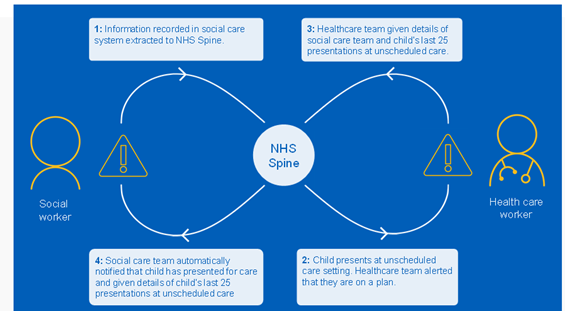
Benefits of CP-IS
- Early Intervention – Acting to prevent and or reduce future harm happening to children – With instant access to CP-IS information, communication with the appropriate Social Worker can occur quickly, leading to a better outcome for the child.
- Because the Social Worker is notified immediately if a child in their care has presented at an unscheduled care setting, they are better placed to assess whether any intervention is needed to achieve a good outcome for the child.
- Improved safety and care – Doing the best when children need help – Because health practitioners (in unscheduled and now scheduled care settings) can see CP-IS information about a child anywhere in England, they will be better equipped to make the right decision about that child’s care.
- Increased workforce efficiency and effectiveness – Doing the most for children with the resources we have – Because CP-IS automatically sends information to the NHS Spine daily, it is always up to date.
Child Health Information Service
A CHIS is an NHS commissioned service that is responsible for collating data from various organisations for all children aged 0-19 that are either residents or registered with a GP Practice in a specified area, into a single Child Health Record. The child health record begins from birth of the child and monitors the care processes and screening of the child, such as Newborn Blood Spot or hearing assessments through to the various immunisations (stated within the NHS National Vaccination Schedule). Data is received from with organisations such as Public Health, Health Visitors, School Nursing and Immunisations teams to help with increasing vaccination coverage to prevent outbreaks of disease, supporting the healthy child programme, assisting in the delivery of children’s public health services and safeguarding vulnerable children.
The aims of our CHIS services are to:
- Have a Child Health Record for each and every child within our area, regardless of the child is registered at a GP Practice or not
- Obtain all data from the respective care provider(s) for all children for the aspects of care given to each child, for example screening and immunisation
- Provide NHS compliant data sharing arrangements which will allow the appropriate healthcare professionals and parent/guardians to access the child health records
- Eradicate costly paper based data flows with more efficient electronic interfaces to receive the information more quickly
Our CHIS services adhere to the latest NHS England Service Specification and through our innovation and passion to improve the health of children, we meet the aims and objectives of the NHS Child Health Digital Strategy.
Research – National Institute for Health & Social Care Research (NIHR) – Clinical Research Network
Clinical Research Network West Midlands (CRN WM) provides a research delivery service to GP practices across the West Midlands. All CRN WM Delivery Support staff are employed by The Royal Wolverhampton NHS Trust. All NHS Staff members who have been allocated to work within the Practice will be issued with a Letter of access or assurance to confirm individual study placements and pre-employment checks.
The legal bases for processing this information
CRN WM processes data under the instruction of the individual research protocol, as delegated by the practice (data controller). You can opt out of being invited to participate in research at any time, please inform a member of the practice team and we will add the appropriate opt out code to your record.
Prior to informed consent:
The legal basis which allows us to process your personal data for research is GDPR article 6 (1)(f) …legitimate interests…except where such interests are overridden by the interests or fundamental rights and freedoms of the data subject…’
Once informed consent has been given:
The legal basis which allows us to process your personal data is informed consent – Article 6 1(a) the data subject has given consent to the processing of his or her personal data for one or more specific purposes; and Article 9 (2) (a) the data subject has given explicit consent to the processing those personal data for one or more specified purposes.
Individual study consent forms will detail how to withdraw consent and who to contact, this will usually be via the study sponsor.
Categories of personal data
The data processed by CRN WM delivery staff, in addition to demographic and contact details, is likely to be special category information (such as health information) to determine eligibility for individual research studies.
Recipients of data
The data processed by CRN WM delivery staff will be used to invite potentially eligible patients into research studies. Once patients have consented to participate, data processed by the CRN WM delivery staff will be used to answer the research questions as outlined in individual research protocols.
For further information, please refer to the Clinical Research Network West Midlands Privacy Notice: https://local.nihr.ac.uk/documents/crn-wm-privacy-notice-march-2021/27187
Research
Clinical Practice Research Datalink (CPRD) collects de-identified patient data from a network of GP practices across the UK. Primary care data are linked to a range of other health related data to provide a longitudinal, representative UK population health dataset. You can opt out of your information being used for research purposes at any time (see below), full details can be found here: https://cprd.com/transparency-information
The legal bases for processing this information
CPRD do not hold or process personal data on patients; however, NHS Digital (formally the Health and Social Care Centre) may process ‘personal data’ for us as an accredited ‘safe haven’ or ‘trusted third-party’ within the NHS when linking GP data with data from other sources. The legal bases for processing this data are:
- Medicines and medical device monitoring: Article 6(e) and Article 9(2)(i) – public interest in the area of public health
- Medical research and statistics: Article 6(e) and Article 9(2)(j) – public interest and scientific research purposes
- Any data CPRD hold or pass on to bona fide researchers, except for clinical research studies, will have been anonymised in accordance with the Information Commissioner’s Office Anonymisation Code of Practice. We will hold data indefinitely for the benefit of future research, but studies will normally only hold the data we release to them for twelve months.
Categories of personal data
The data collected by Practice staff in the event of a safeguarding situation will be as much personal information as is possible that is necessary to obtain in order to handle the situation. In addition to some basic demographic and contact details, we will also process details of what the safeguarding concern is. This is likely to be special category information (such as health information).
Sources of the data
The Practice will either receive or collect information when someone contacts the organisation with safeguarding concerns, or we believe there may be safeguarding concerns and make enquiries to relevant providers.
Recipients of personal data
The information is used by the Practice when handling a safeguarding incident or concern. We may share information accordingly to ensure duty of care and investigation as required with other partners such as local authorities, the police or healthcare professionals (i.e. their GP or mental health team).
Third party processors
To deliver the best possible service, the practice will share data (where required) with other NHS bodies such as other GP practices and hospitals. In addition, the practice will use carefully selected third party service providers. When we use a third-party service provider to process data on our behalf then we will always have an appropriate agreement in place to ensure that they keep the data secure, that they do not use or share information other than in accordance with our instructions and that they are operating appropriately. Examples of functions that may be carried out by third parties include:
- Companies that provide IT services & support, including our core clinical systems; systems which manage patient facing services (such as our website and service accessible through the same); data hosting service providers; systems which facilitate appointment bookings or electronic prescription services; document management services etc.
- Delivery services (for example if we were to arrange for delivery of any medicines to you).
- Payment providers (if for example you were paying for a prescription or a service such as travel vaccinations).
Further details regarding specific third-party processors can be supplied on request to the Data Protection Officer as below.
How do we maintain the confidentiality of your records?
We are committed to protecting your privacy and will only use information collected lawfully in accordance with:
- Data Protection Act 2018
- The General Data Protection Regulations 2016
- Human Rights Act 1998
- Common Law Duty of Confidentiality
- Health and Social Care Act 2012
- NHS Codes of Confidentiality, Information Security and Records Management
- Information: To share or not to share review
Every member of staff who works for an NHS organisation has a legal obligation to keep information about you confidential.
We will only ever use or pass on information about you if others involved in your care have a genuine need for it. We will not disclose your information to any third party without your permission unless there are exceptional circumstances (i.e. life or death situations), where the law requires information to be passed on and / or in accordance with the information sharing principle following Dame Fiona Caldicott’s information sharing review (Information to share or not to share) where “The duty to share information can be as important as the duty to protect patient confidentiality.” This means that health and social care professionals should have the confidence to share information in the best interests of their patients within the framework set out by the Caldicott principles.
Our practice policy is to respect the privacy of our patients, their families and our staff and to maintain compliance with the General Data Protection Regulations (GDPR) and all UK specific Data Protection Requirements. Our policy is to ensure all personal data related to our patients will be protected.
All employees and sub-contractors engaged by our practice are asked to sign a confidentiality agreement. The practice will, if required, sign a separate confidentiality agreement if the client deems it necessary. If a sub-contractor acts as a data processor for Arden House Medical Practice an appropriate contract (art 24-28) will be established for the processing of your information.
In certain circumstances you may have the right to withdraw your consent to the processing of data. Please contact the Data Protection Officer in writing if you wish to withdraw your consent. In some circumstances we may need to store your data after your consent has been withdrawn to comply with a legislative requirement.
Some of this information will be held centrally and used for statistical purposes. Where we do this, we take strict measures to ensure that individual patients cannot be identified. Sometimes your information may be requested to be used for research purposes – the surgery will always gain your consent before releasing the information for this purpose in an identifiable format. In some circumstances you can opt-out of the surgery sharing any of your information for research purposes.
With your consent we would also like to use your information
There are times that we may want to use your information to contact you or offer you services, not directly about your healthcare, in these instances we will always gain your consent to contact you. We would however like to use your name, contact details, and email address to inform you of other services that may benefit you. We will only do this with your consent. There may be occasions where authorised research facilities would like you to take part on innovations, research, improving services or identifying trends, you will be asked to opt into such programmes if you are happy to do so.
At any stage where we would like to use your data for anything other than the specified purposes and where there is no lawful requirement for us to share or process your data, we will ensure that you have the ability to consent and opt out prior to any data processing taking place.
This information is not shared with third parties or used for any marketing and you can unsubscribe at any time via phone, email or by informing the practice DPO as below.
National opt-out facility
You can choose whether your confidential patient information is used for research and planning.
Who can use your confidential patient information for research and planning?
It is used by the NHS, local authorities, university and hospital researchers, medical colleges and pharmaceutical companies researching new treatments.
Making your data opt-out choice
You can choose to opt out of sharing your confidential patient information for research and planning. There may still be times when your confidential patient information is used: for example, during an epidemic where there might be a risk to you or to other people’s health. You can also still consent to take part in a specific research project.
Will choosing this opt-out affect your care and treatment?
No, your confidential patient information will still be used for your individual care. Choosing to opt out will not affect your care and treatment. You will still be invited for screening services, such as screenings for bowel cancer.
What should you do next?
You do not need to do anything if you are happy about how your confidential patient information is used.
If you do not want your confidential patient information to be used for research and planning, you can choose to opt out securely online or through a telephone service.
You can change your choice at any time
To find out more or to make your choice visit NHS: Your NHS Data Matters or call 0300 303 5678.
NHS Digital Data Collection from the Practice
Clinical system – EMIS also known as Optum
Data Use Objections / Complaints
Telephone System
Our telephone system records all telephone calls. Recordings are retained for up to three years, and are used periodically for the purposes of seeking clarification where there is a dispute as to what was said and for staff training. Access to these recordings is restricted to named senior staff.
Video Consultations
The practice may use video consultations to see patients who may not need to attend the surgery in person, all such systems are NHS security checked and authorised, the practice has a video consultation policy and the statutory powers to process your data via this method of communication, are as above for direct care.
Summary Care Records
To support your care and improve the sharing of relevant information to our partner organisations when they are involved in looking after you, we will share information to other systems. The general principle is that information is passed to these systems unless you request this does not happen, but that system users should ask for your consent before viewing your record.
We may also use external companies to process personal information, such as for archiving purposes. These companies are bound by contractual agreements to ensure information is kept confidential and secure. All employees and sub-contractors engaged by our practice are asked to sign a confidentiality agreement. If a sub-contractor acts as a data processor for Arden House Medical Practice an appropriate contract (art. 24-28) will be established for the processing of your information.
Sharing your information without consent
We will normally ask you for your consent, but there are times when we may be required by law to share your information without your consent, for example:
- Where there is a serious risk of harm or abuse to you or other people
- Where a serious crime, such as assault, is being investigated or where it could be prevented
- Notification of new births
- Where we encounter infectious diseases that may endanger the safety of others, such as meningitis or measles (but not HIV/AIDS)
- Where a formal court order has been issued
- Where there is a legal requirement, for example if you have committed a road traffic offence
How long will we store your information?
We are required under UK law to keep your information and data for the full retention periods as specified by the NHS Records Management code of practice for health and social care and national archives requirements.
More information on records retention can be found online at www.digital.nhs.uk.
How can you access, amend move the personal data that you have given to us?
Even if we already hold your personal data, you still have various rights in relation to it. To get in touch about these, please contact us. We will seek to deal with your request without undue delay, and in any event in accordance with the requirements of any applicable laws. Please note that we may keep a record of your communications to help us resolve any issues which you raise.
Right to object: If we are using your data because we deem it necessary for our legitimate interests to do so, and you do not agree, you have the right to object. We will respond to your request within 30 days (although we may be allowed to extend this period in certain cases). Generally, we will only disagree with you if certain limited conditions apply.
Right to withdraw consent: Where we have obtained your consent to process your personal data for certain activities (for example for a research project), or consent to market to you, you may withdraw your consent at any time.
Right to erasure: In certain situations (for example, where we have processed your data unlawfully), you have the right to request us to “erase” your personal data. We will respond to your request within 30 days (although we may be allowed to extend this period in certain cases) and will only disagree with you if certain limited conditions apply. If we do agree to your request, we will delete your data but will generally assume that you would prefer us to keep a note of your name on our register of individuals who would prefer not to be contacted. That way, we will minimise the chances of you being contacted in the future where your data are collected in unconnected circumstances. If you would prefer us not to do this, you are free to say so.
Right of data portability: If you wish, you have the right to transfer your data from us to another data controller. We will help with this with a GP to GP data transfer and transfer of your hard copy notes.
Access to your personal information
Data Subject Access Requests (DSAR)
You have a right under the Data Protection legislation to request access to view or to obtain copies of what information the surgery holds about you and to have it amended should it be inaccurate.
To request this, you need to do the following:
- Your request should be made to the practice – for information from the hospital you should write direct to them
- There is no charge to have a copy of the information held about you
- We are required to respond to you within one month
- You will need to give adequate information (for example full name, address, date of birth, NHS number and details of your request) so that your identity can be verified, and your records located information we hold about you at any time
What should you do if your personal information changes?
You should tell us so that we can update our records. Please contact the practice manager as soon as any of your details change, this is especially important for changes of address or contact details (such as your mobile phone number). The practice will from time to time ask you to confirm that the information we currently hold is accurate and up-to-date.
Objections / complaintsInformation Commissioner
Wycliffe house
Water Lane
Wilmslow
Cheshire
SK9 5AF
Phone
01625 545745
Website
www.ico.org.uk
If you are happy for your data to be extracted and used for the purposes described in this privacy notice, then you do not need to do anything. If you have any concerns about how your data is shared, then please contact the Practice Data Protection Officer.
If you would like to know more about your rights in respect of the personal data we hold about you, please contact the Data Protection Officer as below.
Data Protection Officer
The Practice Data Protection Officer is Paul Couldrey, of PCIG Consulting Limited. Any queries regarding Data Protection issues should be addressed to him at:
Email
Couldrey@me.com
Postal
PCIG Consulting Limited
7 Westacre Drive
Quarry Bank
Dudley
West Midlands
DY5 2EE
Changes
It is important to point out that we may amend this privacy notice from time to time. If you are dissatisfied with any aspect of our privacy notice, please contact the Practice Data Protection Officer.